


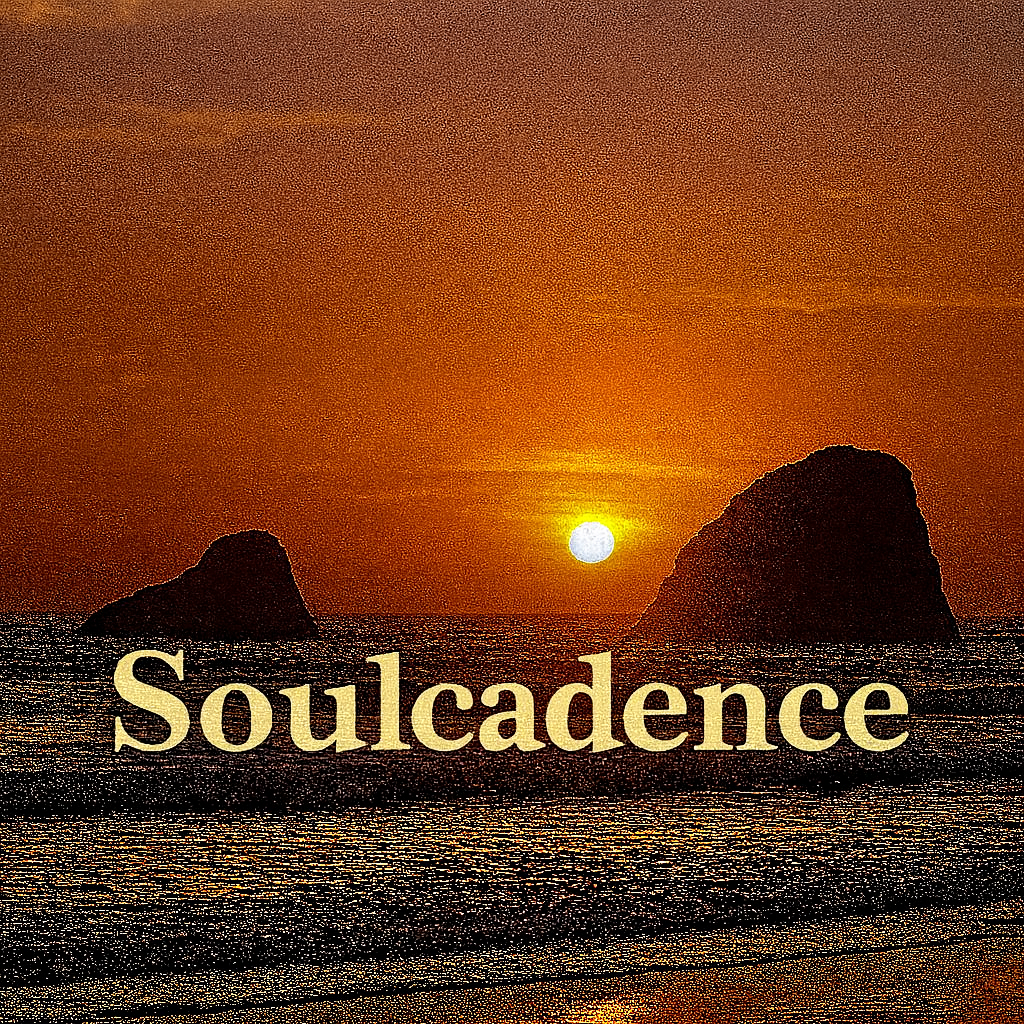
Have you ever experienced a moment in nature that left you spellbound, feeling an inexplicable connection to something greater than yourself?
Sometimes these encounters change the course of our lives. They awaken something within us, opening doors to places we never imagined existed.
For me, that moment occurred on Goat Rock Beach, along the rugged Sonoma County coastline in Northern California.
What began as an extraordinary spiritual experience would lead to a mysterious guitar tuning, a song called “Shining Light,” and a lifelong exploration of the relationship between music, consciousness, and the unseen forces of creation.
The Night at Goat Rock Beach
That evening, I walked along the shore, mesmerized by the moon darting in and out of the coastal fog. The ocean seemed to breathe with the rhythm of the universe.
An overwhelming sense of peace and joy came over me. I felt as though I was being watched over by something greater than myself. Love and tranquility filled my heart, and the sensation endured for hours.
It was unlike anything I had experienced before—a moment when the boundaries between the physical and spiritual worlds seemed to dissolve.
That night, I had a lucid dream.
In the dream, I heard beautiful, harp-like music. The sound was unfamiliar, yet carried an extraordinary sense of recognition, as though I were remembering something rather than hearing it for the first time.
When I awoke the following morning, the sound remained with me.
I picked up my guitar and began changing the tuning of its six strings, searching for the harmonics I had heard in my dream.
I arrived at an unusual configuration:
D♯–A♯–D–G–G–D
I call it Shine Tuning.
What happened next remains one of the great mysteries of my musical life.
Without practicing or learning to navigate this unfamiliar tuning, I began playing. Within approximately five minutes, I had written an entire song, “Shining Light,” in one continuous creative passage.
After a lifetime studying and performing music, beginning as a classical violinist at the age of four, I understood how unusual this was. An unfamiliar tuning typically requires time to develop the musical vocabulary and instinct necessary to compose fluently.
Yet the music and lyrics seemed to arrive together, effortlessly, as though they had already existed somewhere beyond my conscious awareness.
It was only after reading the lyrics that I recognized their deeper meaning.
The song spoke to the loss of my mother, who had died unexpectedly from a brain aneurysm.
A sense of sacred wonder washed over me.
Was the music an expression of grief buried deep within my subconscious? Was it a message from somewhere beyond ordinary perception? Or had I experienced a moment when memory, emotion, and creativity converged in a way I could not explain?
I still don't know.
But I knew something extraordinary had happened.
The Birth of Soulcadence
The experience drew me deeper into mysticism, Buddhist philosophy, and the idea that all existence is interconnected.
The atoms that make up our bodies have traveled through the universe for billions of years, continually transforming, becoming part of new forms of life. In that sense, we are connected to everything that came before us.
I began to wonder whether music might be another expression of that continuity.
Could sound carry the emotional imprint of those who came before us? Could the vibrations we create become vessels for remembrance, healing, and spiritual connection?
Could a melody somehow reconnect us with someone we have lost?
And was Goat Rock Beach a sacred place where, for one extraordinary moment, the boundaries between memory, consciousness, and something greater had disappeared?
These questions gave birth to Soulcadence, my spiritual and creative philosophy exploring sound as a force of connection, remembrance, healing, and renewal.
Soulcadence is rooted in the belief that music is more than entertainment. It is a living expression of our experiences, emotions, memories, and the mysterious forces that inspire us.
Every artist carries a lifetime within their creative voice. Every song becomes a reflection of the human spirit that brought it into existence.
The Human Signature of Music
As I continued exploring Shine Tuning, I became fascinated by the distinctive relationships between its strings, the harmonics they produced, and the unexpected musical possibilities they revealed.
I began to think about something beyond the notes themselves.
What makes a piece of music unmistakably human?
Is it the way a guitarist bends a note, the hesitation before a phrase, the emotional weight behind a lyric, or the subtle imperfections that give a performance its character?
Two musicians can play the same notes, yet the music will never feel exactly the same. Each brings a lifetime of experience to the instrument.
These questions inspired Creator DNA, a technology I am developing to help protect the authenticity and provenance of human creativity in an age of artificial intelligence.
Creator DNA is envisioned as a human creative provenance ledger—a system designed to recognize and preserve the distinctive patterns of human expression over time, helping distinguish authentic human creation and identity from synthetic copies and AI-generated impersonations.
Its origins trace back to Shine Tuning and a simple realization: every human being brings something uniquely their own to the act of creation.
The tuning was born from a dream. The song emerged from an experience I could barely explain. And its meaning was inseparable from the memory of my mother.
What began as a spiritual encounter on a California beach has grown into an exploration of how we might preserve and protect the human origin of creative expression.
Machines may learn to imitate our voices, our music, and our artistic styles. But imitation is not the same as human origin.
For me, Creator DNA represents an effort to honor that distinction, to protect not just what we create, but the human beings and life experiences behind it.
The journey from Shine Tuning to Creator DNA has brought me full circle, back to the question that began on Goat Rock Beach:
Where does creativity come from, and how do we preserve the human spirit that gives it life?
Where Does a Song Begin and End?
I often return to that night at Goat Rock Beach.
The moon moving through the fog. The extraordinary peace I felt standing beside the ocean. The harp-like music in my dream. The unfamiliar tuning that somehow felt natural beneath my fingers.
And the realization that “Shining Light” was connected to the memory of my mother.
I have sometimes described the experience by saying:
“Shining Light” wasn't written. It was received.
That is how the moment felt to me.
Whether its origin lay in the subconscious, the mysterious workings of creativity, or something beyond my understanding remains an open question.
But the experience changed my relationship with music.
It opened a new realm of musical exploration, where sound became a bridge between memory and imagination, between the physical world and the mysteries of consciousness.
It also reminded me that some of the most meaningful creative moments arrive when we surrender the need to understand everything.
After a lifetime in music, those moments still mean everything to me: picking up an instrument, hearing something I've never heard before, and discovering a song that seems to have been waiting for me all along.
Perhaps the most interesting question isn't where music comes from, but how much of it exists before we become aware of it.
Shine Tuning began with a dream. Soulcadence became a way of understanding the experience. Creator DNA became a way of honoring the individuality of human creation.
And “Shining Light” remains the song that connects them all.
Peace and Love,
Scot Sier